

For years, I’ve worked in parallel as both a UX strategist designing complex systems and a writer exploring literary narratives rooted in cultural memory. The deeper the work goes, the more apparent it becomes: these aren’t separate crafts—they’re parallel practices of making complex worlds navigable.
Both design and storytelling begin with guiding attention—but they don’t end there. They create pathways through complexity, decide what surfaces when, and recognize that the order of revelation shapes what people choose to notice, understand, and pursue. This isn’t metaphor. It’s structural.
The Architecture of Attention
When designing a product experience, a designer choreographs where users look, what they notice, and how they move through information. This isn’t manipulation—it’s necessity. Without intentional architecture, complexity becomes chaos. The same principle governs narrative: writers create structures that guide readers through emotional and conceptual territory, revealing information in sequences that allow understanding to build.
Both practices require understanding that attention is finite and precious. In UX, designers talk about cognitive load and progressive disclosure. In storytelling, writers talk about pacing and narrative tension. These are different vocabularies for the same fundamental challenge: how to guide someone through complexity without overwhelming them, while ensuring nothing essential disappears.
The parallel becomes even clearer when examining what both practices wrestle with: the politics of visibility. What gets foregrounded and what recedes shapes what becomes knowable. In design, this might mean deciding which product features appear in primary navigation versus three layers deep. In narrative, it might mean choosing which cultural perspectives anchor a story versus which remain peripheral. Neither choice is neutral.
Systems Thinking as Craft
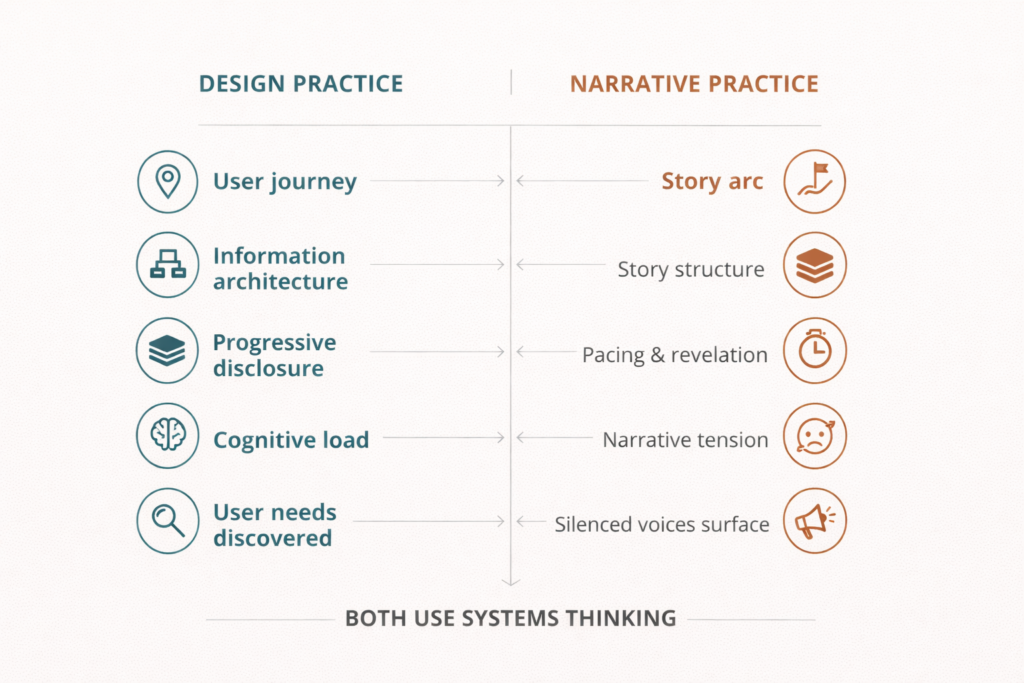
Narrative structure is a system. So is a well-designed product experience. Both require holding the entire architecture in mind while attending to each moment of encounter.
What makes both practices particularly compelling is that they’re not just about guiding attention—they’re also about understanding how elements interconnect to create meaning. This is where systems thinking becomes craft.
In UX, designers map user journeys: the paths people take through a product, the transitions between states, the moments requiring reassurance or clarity. Writers construct similar arcs: story structures with transitions, moments of recognition, and carefully timed revelations. Both are designing how meaning accumulates through sequence.
The craft in both cases is understanding that the whole is not just the sum of parts—it’s how those parts interconnect to create coherent experience.
What This Reveals
The notion that one practice is “strategic” while the other is “creative” misses something fundamental. Both require the same core capacity: seeing systems, understanding how information flows through them, and making choices about what that flow reveals, how it reveals it, and when.
Recognizing this parallel helps clarify what good design and good writing actually require. Strong UX strategy asks: what story does this product tell about what’s possible? Where does confusion arise because the structure doesn’t support the journey being asked of users? Strong narrative work asks parallel questions: what narrative structure would help readers hold this complexity emotionally? Where does friction exist not because readers need to sit with difficulty, but because the right pathways haven’t been built?
Both practices solve the same problem: how to build architectures where attention, revelation, and meaning unfold in ways that serve understanding. Every choice about what surfaces, and when, is also a choice about what becomes possible to know.